
Introduction To Screen Readers – Mobile
On this page:
- Date, Time, Venue
- Programme Description
- Learning Outcomes
- How This Module Relates To The A11Y Roadmap
- Target Audience
- Pre-requisites
- Class Size
- Accessibility
- Trainers
- Pricing
- Registration
- Express Your Interest
- Contact
Date, Time, Venue
Date: 28 February 2026 (Saturday)
Time: 2pm to 5pm
Venue: Equal Dreams Office (994 Bendemeer Rd, #03-04, Room 5, B-Central, Singapore 339943)
Programme Description
This in-person, hands-on programme introduces participants to how screen readers work on mobile devices, focusing on VoiceOver (iPhone) and TalkBack (Android). Participants will experience first-hand how Blind and Low Vision (BLV) users navigate apps, web pages, and documents using touch-based screen reader interaction.
Rather than teaching rules or checklists, the session centres lived experience. Participants will actively use a mobile screen reader to explore real digital content, helping them understand how accessibility decisions directly affect usability in everyday mobile contexts.
This programme focuses specifically on mobile screen reader use. Participants who want a fuller understanding of how screen readers work across platforms are strongly encouraged to also attend Introduction to Screen Readers — Desktop (Windows NVDA), held earlier the same day and registered separately.
How This Module Fits the A11y Roadmap
This is a standalone module that can be taken at any point in the A11y Roadmap.
By centring the lived experience of screen reader users, this programme supports deeper understanding and appreciation of the skills covered in:
- Essential Skills of Digital Accessibility, and
- Category 2: Platform Skills & Practice modules (Documents, Presentations, Spreadsheets, Web, Social Media)
Participants may take this programme before, after, or alongside other modules. Many learners find that experiencing mobile screen reader use strengthens their ability to apply accessibility practices more meaningfully, especially for mobile-first content such as social media and web pages.
Learning Outcomes
By the end of this introductory webinar, participants will:
- Understand what mobile screen readers are, who uses them, and how they work
- Experience first-hand how Blind and Low Vision users navigate content on mobile devices
- Safely activate and deactivate VoiceOver and TalkBack
- Recognise how structure, semantics, and accessibility practices affect mobile usability
- Identify common accessibility barriers in apps, web pages, and mobile documents
- Perform basic, informal user testing of everyday mobile digital content using a screen reader
- Build confidence discussing accessibility and usability from a user-centred perspective
Target Audience
For anyone who creates, reviews, commissions, or manages digital content — including educators, programme staff, operations teams, communications and social media teams, designers, and general professionals.
This programme is especially suited for participants who want to:
- better understand the user experience of Blind and Low Vision users, and
- perform basic user testing on everyday digital content frequently accessed on mobile (e.g. websites, social media posts, messaging platform) to identify obvious accessibility barriers.
No prior experience with screen readers or accessibility is required.
Pre-requisites
- Participants should bring their own Mobile Devices
- No prior setup is required; guidance will be provided during the session
Class Size
Limited to 18 pax
Note: There needs to be a minimum pax of 8 participants to conduct the programme. If the minimum number is not reached, you will be informed before the start of the programme to be refunded. There’s no refund of programme fees once paid, unless the programme is cancelled.
Accessibility
We are committed to creating a programme experience that is inclusive, accessible and affirming of diverse accessibility needs. Read on to find out more about the access arrangements available for this programme!
- Presenters will actively speak at a moderate pace and encourage one speaker at a time to facilitate smoother information processing
- Multiple modes of expression for processing information and responding, particularly verbal and written modes
- Breaks
- Session notes reflecting slides’ content sent before start of programme
- Programme outline sent before start of programme
- Glossary of all technical terms used in the course
- Materials provided in screen-reader-friendly formats
- Captions for all audio content
Please send in your request at least 2 weeks prior to the programme date.
- Speech-to-Text Interpreting (STTI) to be viewed on your own devices like phone or laptop.
- Singapore Sign Language interpretation.
If you require an accessibility arrangement not listed above, please contact us. We will work with you to identify a suitable or equivalent access option within our available resources.
Trainers
Neo Kah Wee, Digital Accessibility Specialist at Equal Dreams
Kah Wee is a Digital Accessibility Specialist at Equal Dreams with deep-rooted lived experience as a Person with Visual Impairment. He holds a Diploma in Multimedia & Infocomm Technology from Nanyang Polytechnic, which provides a strong technical foundation for his work in digital accessibility, assistive technology, and inclusive digital experiences. Kah Wee’s journey in accessibility began as an Assistive Technology Trainer, where he taught individuals who are blind or have low vision to effectively use screen readers and mainstream digital tools. He previously served in this role at Guide Dogs Singapore, equipping clients with practical skills to achieve greater independence and confidence in their daily digital interactions. This early professional experience shaped his strong user-centred and empathy-driven approach to accessibility. As a Visually Impaired himself he is motivated by a firm belief that meaningful change requires both collective societal effort and individual advocacy, Kah Wee actively promotes accessibility awareness, continuous improvement, and inclusive practices. He also encourages persons with disabilities to take an active role in shaping their own representation, recognition, and participation within society. In addition to his organisational roles, Kah Wee has undertaken freelance accessibility projects with companies such as Beyonsoft, collaborating with product and development teams to evaluate and enhance the accessibility of digital platforms. These engagements strengthened his ability to translate accessibility standards into practical, real-world solutions across different organisational contexts. In his current role at Equal Dreams, Kah Wee conducts accessibility quality assessments and digital accessibility audits, delivers training on accessibility standards and best practices, and serves as an Assistive Technology Trainer, continuing to teach blind and low vision individuals how to navigate digital environments independently. He also collaborates closely with diverse disability communities, recognising that each community offers unique perspectives and strengths. Kah Wee is especially passionate about integrating these insights into his professional practice to drive meaningful, inclusive, and sustainable change.
Dallon Au, Digital Accessibility Specialist
Dallon is a Digital Accessibility Specialist at Equal Dreams and a low-vision individual, born with congenital cataracts, he has partial vision in his left eye and no vision in his right. He recently graduated with a Bachelor of Science in Computing Science (Honours) from the University of Glasgow, UK, through a joint programme with the Singapore Institute of Technology.
One of his most impactful passion projects was his capstone thesis: a web-based solution designed to empower persons with visual impairment to independently fill and sign untagged PDF forms. This proof-of-concept combined assistive technology with intuitive form detection and signature placement features, helping address a long-standing barrier to digital independence.
Prior to joining Equal Dreams, Dallon worked as a freelance trainer at various social service agencies, where he discovered his passion in supporting the Blind and Low Vision (BLV) community. He has trained individuals to use a wide range of assistive technologies, from screen readers to mobile accessibility features, and actively advocates for inclusive design and better representation of the BLV experience in tech development.
At Equal Dreams, Dallon conducts digital accessibility accessibility checks, delivers training on accessibility standards, and continues to teach assistive technology to persons with visual impairments. His work bridges technical expertise with lived experience, driving meaningful accessibility improvements across different projects.
Beyond his current focus, Dallon is eager to deepen his understanding of other disability communities and learn how inclusive design can better serve their unique needs. Through his work at Equal Dreams, he hopes to contribute to accessibility efforts that go beyond visual impairment, ensuring more holistic solutions that reflect the full diversity of human experience.
Pricing
Introduction to the sliding scale pricing model
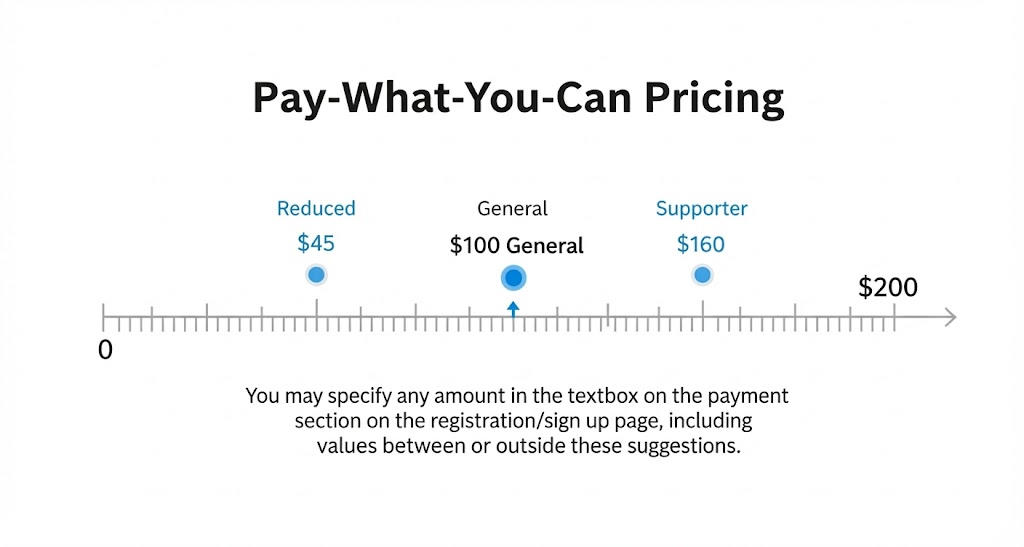
This programme uses a Pay-What-You-Can model so finances are never a barrier. The tiers below are guides only — you may enter any amount that feels right for your circumstances when you’re on the payments section on the registration/sign up page.
Those with greater financial comfort or organisational support are encouraged to contribute more as an act of solidarity.
Any contribution—higher or lower—supports equitable access and helps sustain this work.
Find out more about the ethos behind our pricing models.
Registration
Registration Closed!
👉 Want to understand screen readers on Desktop too?
Join Introduction to Screen Readers — Desktop held in the afternoon and registered separately
Can’t make it this round, but still interested?
Once you registered your interest, we will reach out to you if and when we have the next run of this programme!
Contact
For further enquiries, email us at training@equaldreams.sg